
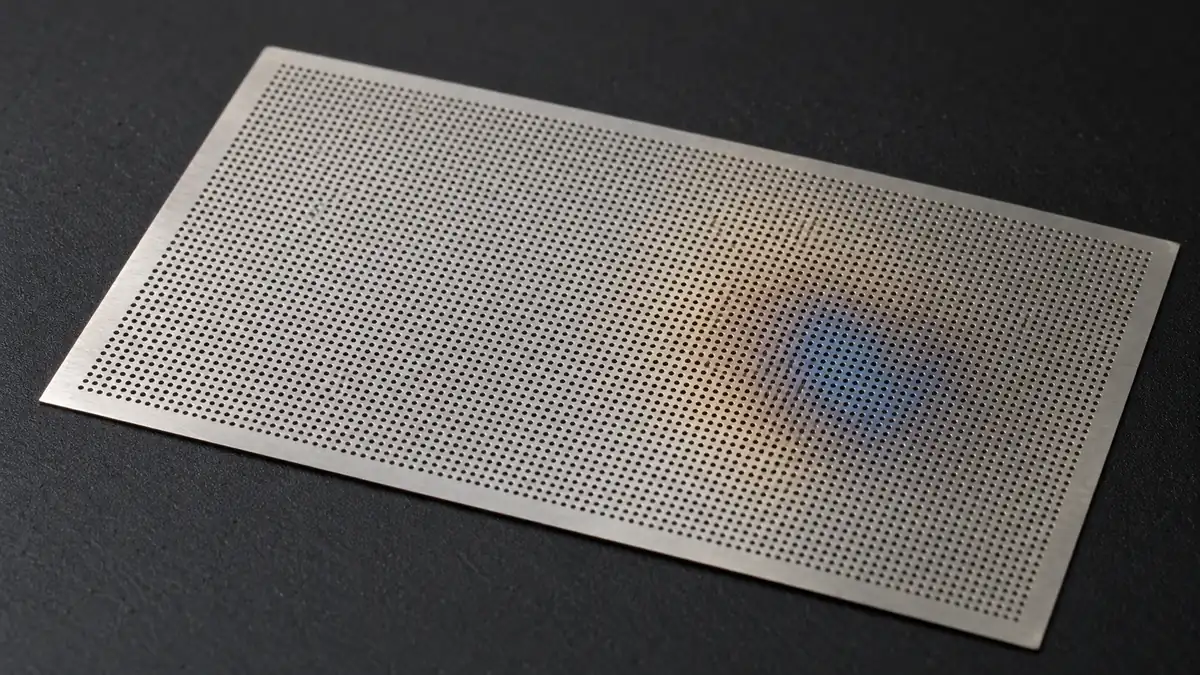
Heat accumulation is what turns a fast laser process into a warped part. Each pulse leaves a little residual heat in the metal, and when the pulses come fast enough that the heat has no time to leave between them, it stacks up. The work zone climbs to a baseline temperature that no single pulse would reach, and the result is a part that distorts, discolors, or grows a wider affected zone than the parameters on paper would predict.
This is a different problem from the heat a single cut leaves at its edge. It is a question of timing: whether the gap between pulses is long enough for the metal to shed what the last pulse put in. At high repetition rates it often is not, and that is where heat accumulation begins.
What heat accumulation actually is
The phrase gets used loosely for any heat problem, so it helps to be precise. Heat accumulation is the buildup of residual heat across many pulses, not the effect of one.
The heat left between pulses
A single pulse deposits energy, removes some material by laser ablation, and leaves a small amount of heat in the metal around the spot. If the next pulse arrives after that heat has diffused away, the metal starts from cold each time. If it arrives sooner, the leftover heat is still there, and the new pulse adds to it rather than starting fresh.
Pulse period against diffusion time
The deciding comparison is between two times. One is the interval between pulses, set by the pulse repetition rate, and the other is the time the material needs to carry heat away from the spot. When the interval is shorter than the diffusion time, heat from each pulse survives into the next, and the baseline temperature climbs pulse by pulse.
Why high repetition rate drives heat accumulation
Repetition rate is the lever that decides whether the pulses outrun the cooling. Pushing it for speed is exactly what tips a process into accumulation.
Pulses arriving faster than heat leaves
Raising the repetition rate shortens the gap between pulses without changing how fast the metal cools. At some rate the gap falls below the diffusion time, and the leftover heat stops clearing between pulses. Past that point, every increase in rate adds to the heat that stays behind.
Average power into a small zone
There is a second way to see it. Average power is pulse energy multiplied by repetition rate, so a high rate pours more total energy per second into a small volume of metal. Even if each pulse is modest, the stream of them delivers an average heating that the work zone has to dissipate, and a small zone cannot dissipate much.
Even short pulses are not immune
A common assumption is that very short pulses stay cold, so accumulation does not apply. The per-pulse heat is indeed small, but at a high enough rate even small amounts add up faster than they leave. Short pulses lower the heat each pulse contributes, which raises the rate at which trouble starts, but they do not remove the ceiling.
How it shows up on the part
Heat accumulation rarely announces itself as heat. It shows up as geometry and surface problems that look like other defects until the pattern points back to temperature.
An affected zone that grows and drifts
The affected zone around the cut widens as the baseline temperature rises, and because the temperature builds over time, the zone is not even along the part. Features cut early, into cold metal, differ from features cut later into metal that has warmed. A process that measured fine on the first feature can drift out by the last.
Distortion and discoloration
As the bulk of a thin part heats, it expands unevenly and locks in stress, which shows up as warp or loss of flatness once it cools. Surface color shifts as oxidation follows the rising temperature. Neither is a cutting error in the usual sense; both are the part telling you it got too hot overall.
Worse in dense patterns
The problem concentrates where features are packed together. In a tight array of holes or a dense pattern, each feature is cut next to metal still warm from the last, so the heat from neighbors adds to the heat from the beam. This is why dense micro-hole arrays, filters, and fine screens are where accumulation bites hardest, and where sequencing the work matters most.
Spreading the heat in space
If accumulation comes from heat piling up in one place, one family of fixes is to not work the same place twice in quick succession. The levers are spatial.
Path spacing
How close adjacent passes or features sit decides how much they share heat. Packing passes tightly puts each one next to metal the last one just warmed, which stacks the temperature. Opening the spacing, where the design allows, gives each path cooler metal to start from.
Scan order and sequencing
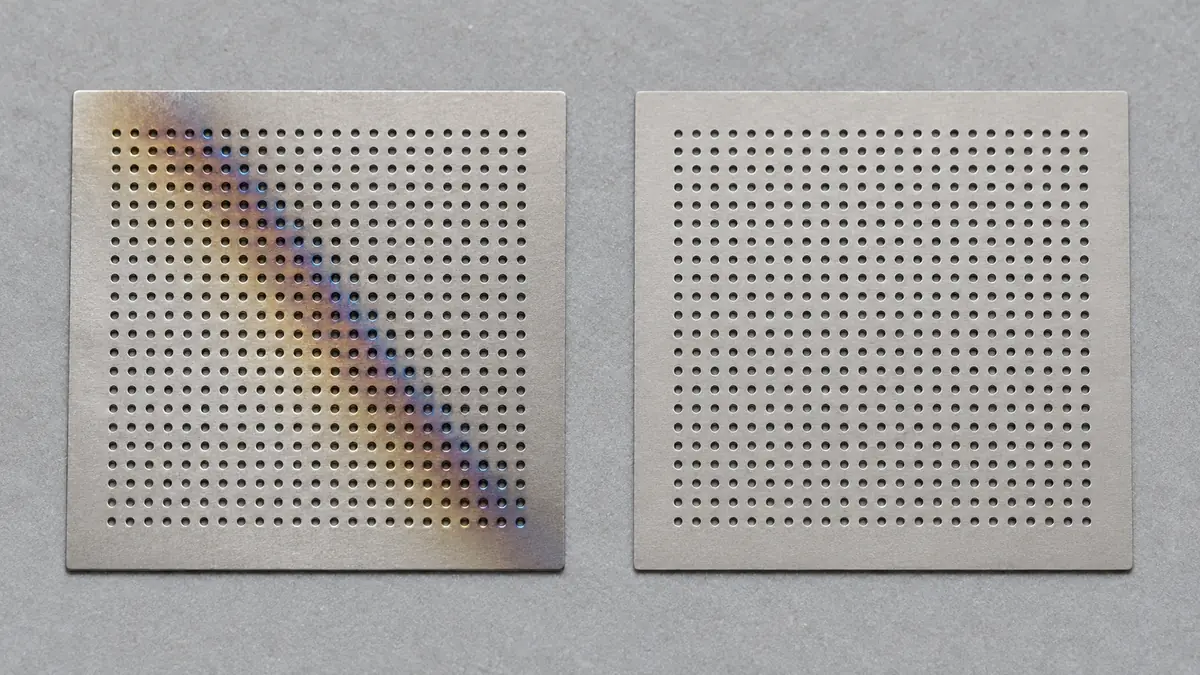
The order in which features are made matters as much as their spacing. Cutting a dense array in simple sequence marches a hot spot across the part, while skipping around so that each feature lands on cold metal spreads the heat out. On a dense hole array, choosing the drilling sequence to avoid returning to a hot region is often the difference between a flat part and a distorted one.
Spreading the heat in time
The other family of fixes works in time rather than space. If the heat needs longer to leave than the pulse interval allows, the answer is to give it that time.
Cooling dwell and intermittent cooling
Building deliberate pauses into the program lets the accumulated heat diffuse before work continues. An intermittent cooling cycle, where the beam steps away from a hot region and returns once it has cooled, holds the baseline temperature down on work that would otherwise run away. It costs time, which is the trade being made.
Splitting the work into passes
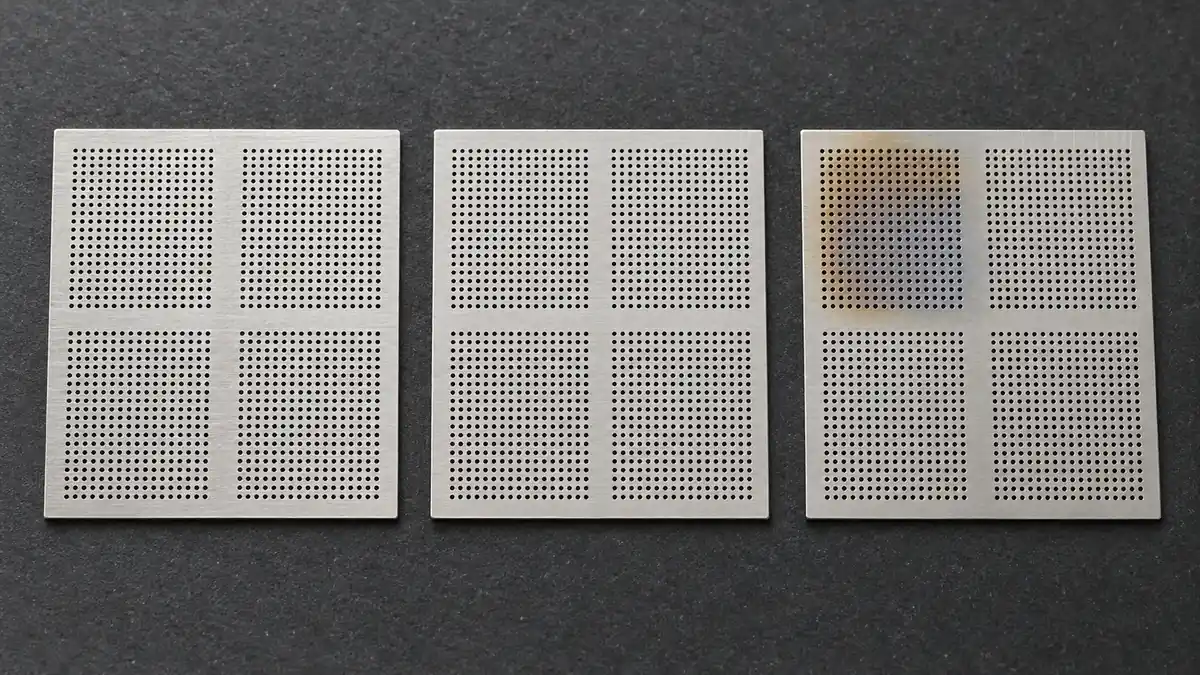
Depth and density can both be broken into several lighter passes with cooling between them, rather than forced in one hot sequence. Each pass adds less heat, and the gaps let the part recover, so the total heat delivered is the same but its peak is lower. The part sees a series of warm cycles instead of one hot one.
Balancing throughput against accumulation
None of this means running slow. It means recognizing that repetition rate is two levers at once, and setting it with both in view.
Rate is a throughput lever and a heat lever
A higher repetition rate finishes a part faster, which is the reason to want it. The same rate raises the heat delivered per second, which is the reason to fear it. The job is to find the highest rate the part tolerates before accumulation shows up, not simply the highest the machine offers.
Finding the usable rate
That rate is found by testing on the actual material and pattern, watching for the point where the affected zone widens or the part starts to distort. It depends on the metal, since a poor conductor holds heat and accumulates sooner, and on the density of the pattern. The usable rate is a property of the part, not a fixed machine setting.
The heat that stays behind
Heat accumulation is a timing problem wearing the disguise of a quality problem. The beam is fine, the parameters look right, and the part still warps or drifts, because the pulses are arriving faster than the metal can let go of what they leave. Once that is understood, the fixes follow directly: spread the heat in space with spacing and sequencing, spread it in time with dwell and passes, and set the repetition rate for the part rather than for the spec sheet.
The parts that come out flat and consistent are the ones where the process was designed around the metal's cooling, not against it. On dense, fine, heat-sensitive work, managing the heat that stays behind is as much the job as making the feature in the first place.