

The size of a laser-made microfeature is usually credited to the spot size, but what really controls it is the fluence and the ablation threshold. Those two ideas explain things the spot size alone cannot, including why a feature can come out finer than the beam that made it, and why the same beam cuts cleanly on one metal and barely marks another.
Pulse energy, fluence, and ablation threshold get used loosely, often as if they were the same quantity. They are not, and the difference between them is where most of the real control over a microfeature lives.
Three terms people blur together
Before any of this is useful, the three terms have to be kept apart. They are related, but each describes something different, and conflating them is how parameters get set by guesswork.
Pulse energy
Pulse energy is the amount of energy in a single laser pulse, measured in joules or more often microjoules at this scale. It is a property of the source and the settings, not of the part. On its own it says nothing about whether the material will be removed, because it does not account for how that energy is spread out.
Fluence
Fluence is the energy delivered per unit area, usually stated in joules per square centimeter. It is the pulse energy divided by the area the beam covers, so the same pulse energy focused to a smaller spot produces a higher fluence. Fluence, not pulse energy, is what the material actually responds to.
Why the distinction matters
The practical consequence is that you can change what the beam does without touching the pulse energy at all. Tighten the focus and the fluence rises because the same energy lands on less area. Two setups with identical pulse energy can sit on opposite sides of the line that decides whether metal is removed.
The ablation threshold
That line has a name. The ablation threshold is the fluence a given material needs before the beam removes any of it, and it is the hinge the whole process turns on.
What the threshold is
Laser ablation begins only when the fluence at the surface exceeds a threshold value. Below it, the energy heats the surface but no material leaves. Above it, the material absorbs enough to vaporize or eject, and a feature starts to form.
Below it nothing, above it material leaves
This threshold behavior is sharper than people expect, particularly with short pulses. A fluence just under the threshold does effectively nothing useful, while a fluence just over it begins clean removal. The process is less a gentle ramp than a line the fluence either crosses or does not.
Every material has its own
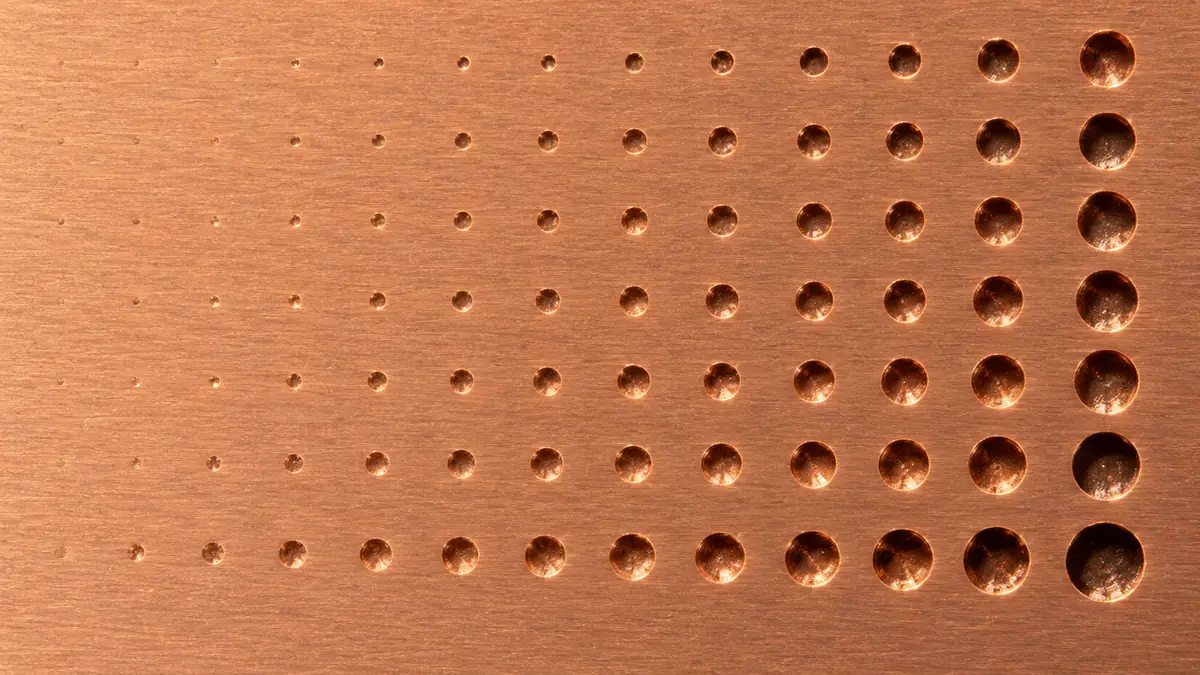
The threshold is a property of the material, not a universal number. A reflective, conductive metal such as copper takes more fluence to reach its threshold than a more absorbing one, which is part of why copper is harder to process. Knowing the threshold for the specific metal is the starting point for setting any fine-feature job.
Why a feature can be smaller than the spot
Here is where fluence and threshold explain something the spot size cannot. A microfeature is not simply the width of the beam stamped into metal.
The beam's fluence profile
A focused beam does not deliver uniform fluence across its width. The fluence is highest at the center and falls off toward the edges, following the beam's profile. The spot has a width, but the fluence inside it is a peak, not a plateau.
Only the part above threshold removes material
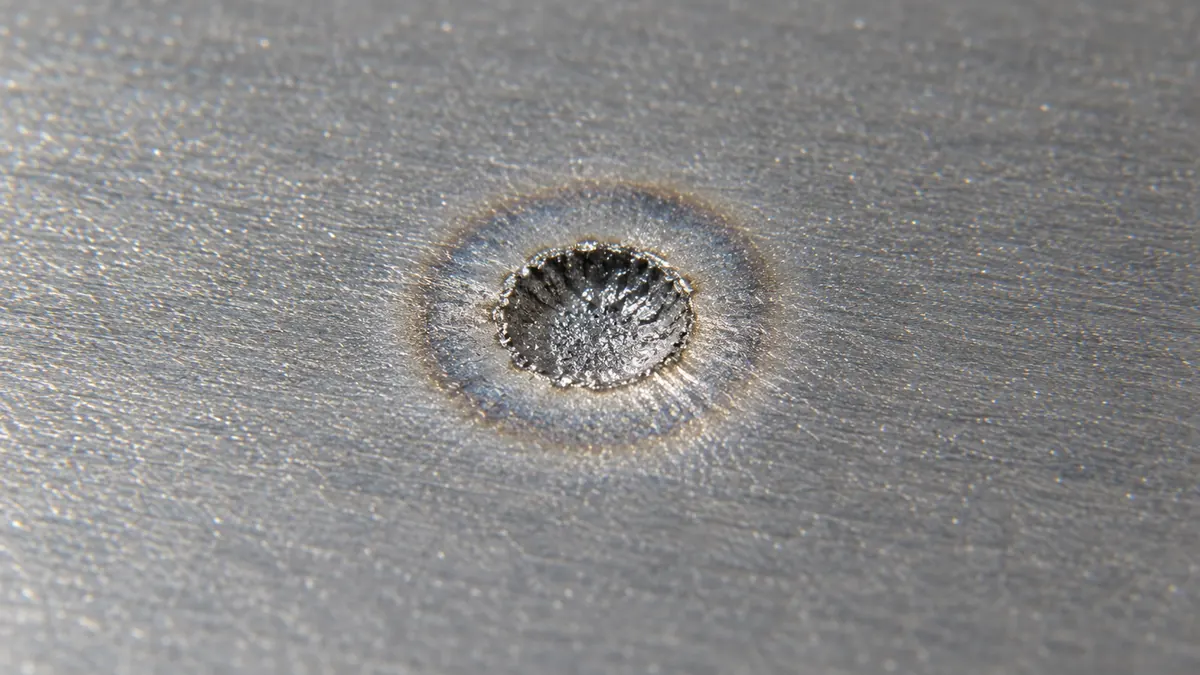
Because removal happens only where fluence exceeds the threshold, the feature is as wide as the above-threshold region, not as wide as the whole beam. When the peak fluence sits only moderately above the threshold, only the central core of the beam clears the line, and the removed feature is narrower than the spot itself.
Threshold machining and sub-spot features
This is the principle behind making features finer than the beam that writes them. By holding the peak fluence close to the threshold, the process uses only the sharp tip of the fluence profile, which is the basis of features shaped by controlled ablation rather than by brute spot size. It is how line widths and structures reach below what the raw spot would suggest.
Tuning the feature with energy, not just focus
Once the feature is understood as the above-threshold region, the controls become clearer. Focus is one lever, but it is not the only one.
Sizing the feature with pulse energy
Raising the pulse energy lifts the whole fluence profile, so more of it clears the threshold and the feature grows wider. Lowering it brings the profile down toward the threshold, and the feature shrinks toward the fine limit. The feature width is tuned by where the profile sits relative to the threshold, which is a question of energy as much as of focus.
Depth from pulses, not from overdriving one
Going deeper is a separate question, and the wrong answer is to overdrive a single pulse. A very high fluence removes more per pulse but dumps excess energy as heat, which widens the affected zone and coarsens the edge. The controlled route is to take more pulses at a sensible fluence, letting depth build up pass by pass rather than forcing it in one shot.
Pulse duration changes the threshold's character
Not all pulses interact with metal the same way, and the pulse duration changes how clean the threshold behaves.
Short pulses, sharp threshold, little heat
With very short pulses, the energy is delivered faster than heat can spread into the surrounding metal, so the threshold is sharp and the material is removed with little heat left behind. This is the regime that produces the cleanest fine features, with a minimal heat-affected zone, because ablation outruns conduction.
Longer pulses, more melt
With longer pulses, more of the energy has time to conduct into the metal as heat, so the removal involves more melting and the threshold is less crisp. The feature can still be good, but the edge carries more recast and the affected zone is wider. Matching pulse duration to how heat-sensitive the part is becomes part of the setup.
Working with the ablation threshold in practice
The theory earns its place when it changes what a shop actually does at the machine. Three habits follow from it.
Find the threshold for the material
The first is to establish where the threshold sits for the specific metal and thickness, rather than carrying a setting over from a different material. A short test that walks the fluence up until clean removal begins locates the line, and everything else is set relative to it.
Stay in the working band
The second is to work in the band above the threshold but below where heat takes over. Too close to the threshold and removal stutters and runs slow. Too far above and the feature coarsens and the heat grows, so the useful window is a range, not a single value.
Hold the pulse energy steady
The third is consistency. If the feature size depends on where the fluence sits relative to the threshold, then a drifting pulse energy means a drifting feature. Holding the source stable, and checking features by measurement, is what keeps a near-threshold process repeatable rather than temperamental.
The number under the feature
A microfeature looks like a geometry problem and is really an energy problem. The spot gives the beam a width, but the fluence profile and the ablation threshold decide how much of that width actually removes metal, how deep each pulse reaches, and how much heat is left behind. Those are the levers that set the size, the edge, and the repeatability of the feature.
Shops that hold fine features well are the ones that think in fluence rather than pulse energy, that know the threshold for the metal in front of them, and that keep the process in the narrow band where removal is clean. The feature on the drawing is made real by a number most drawings never mention.