
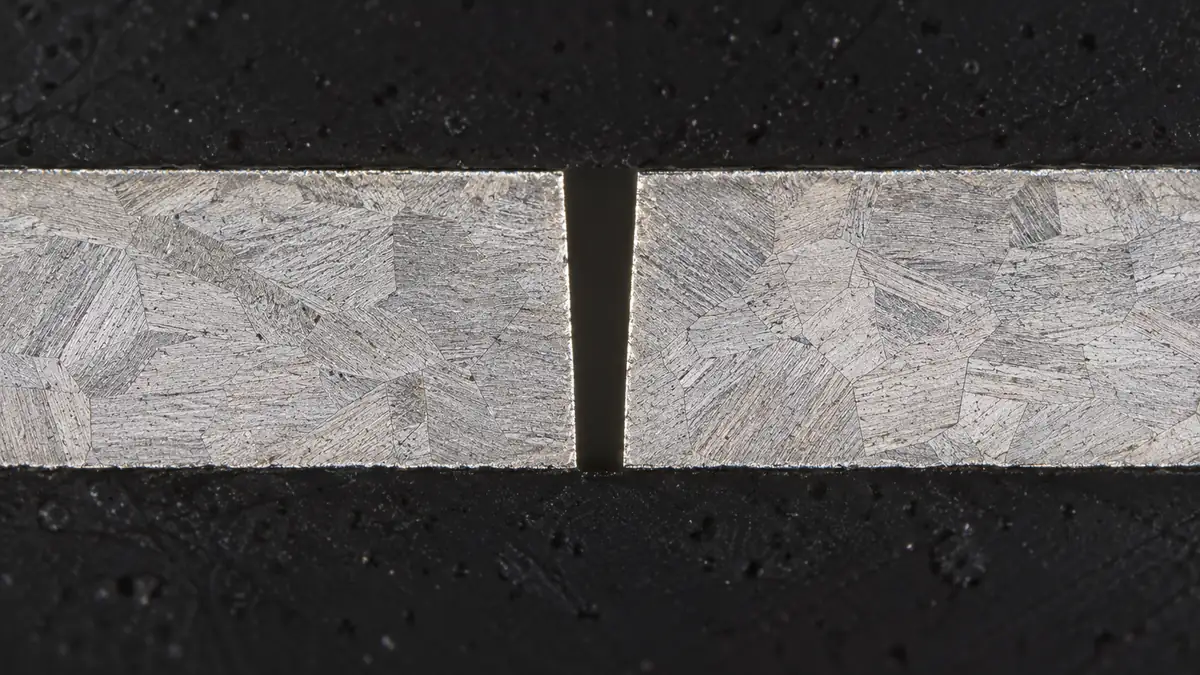
Taper is the defect that shows up when a part measures correctly at the top face and wrong at the bottom. The slot you cut is a hair narrower where the beam exited than where it entered, the hole is slightly conical, and nothing in the program looks wrong. In laser micromachining this almost always comes back to one thing, the behavior of a focused beam through the thickness of the material, and the number that governs it is the Rayleigh range.
Most discussions of fine features stop at spot size, the width of the beam at its narrowest. Taper is a different question. It is not about how small the beam gets, but about how long it stays that small as it passes through the part.
That is a question of focus, and of how steadily the focus holds.
What taper is, and why a laser leaves it
A perfectly square cut would have walls at ninety degrees to both faces. Real cuts rarely do, and understanding why starts with the shape of the beam itself.
A wall that is not square
Taper is the angle between a cut wall and the vertical. On a laser-cut part it shows up as a kerf that is wider at the entrance than the exit, or the reverse, and as holes that are slightly larger on one face.
On thin material it can be small enough to ignore. As the material gets thicker relative to the beam, it grows, and on a part with a tight fit or a mating feature it becomes the thing that fails inspection.
Where the angle comes from
A laser beam does not travel as a parallel column. It converges to a narrow waist at the focus and diverges again beyond it, so its width changes continuously along its path.
The cut takes the width of the beam at each depth, which means the kerf follows the beam's profile through the material. If the waist sits at the top surface, the beam is already widening as it works downward, and the cut inherits that spread as taper.
The Rayleigh range sets your usable depth
The reason taper is tolerable at all is that near the waist the beam stays narrow for some distance before it widens appreciably. How far is set by the Rayleigh range.
What the Rayleigh range is
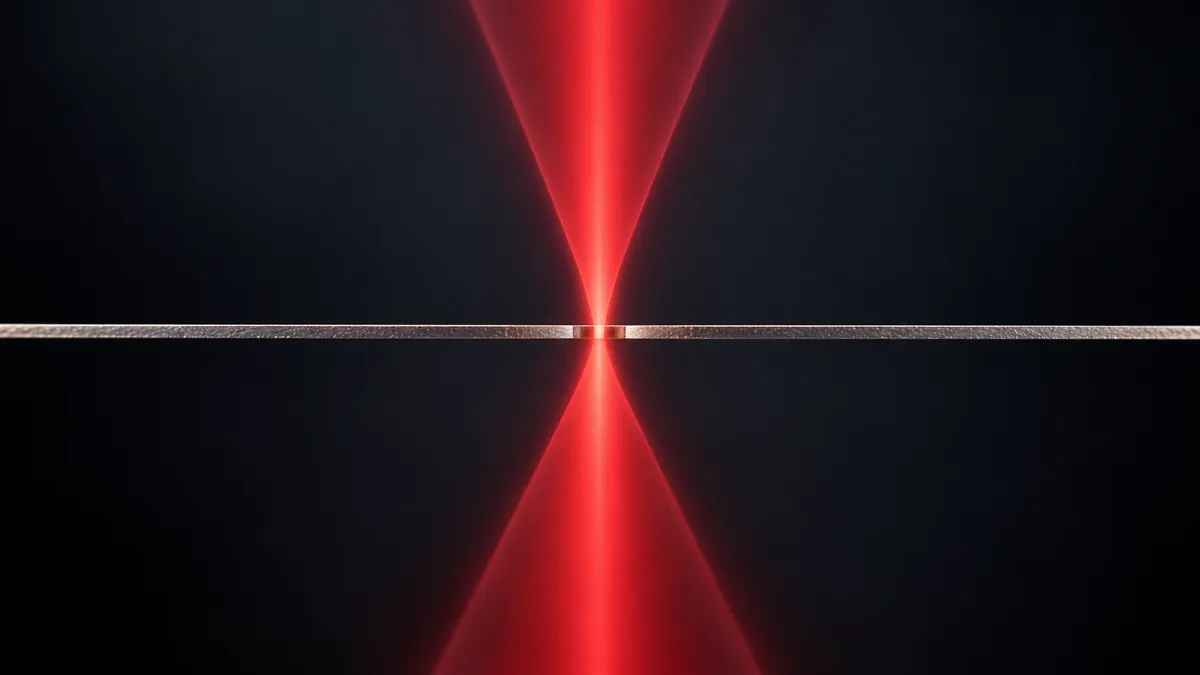
The Rayleigh range is the distance from the waist over which the beam's cross-sectional area roughly doubles, which is to say the distance over which it stays close to its smallest. Twice that length, centered on the waist, is the practical depth of focus: the band of thickness through which the beam is still tight enough to cut a near-straight wall.
Depth of focus against material thickness
Taper is really a contest between that depth of focus and the thickness of the part. When the material is thin compared with the depth of focus, the beam barely changes width across it, and the walls come out close to square. When the thickness approaches or exceeds the depth of focus, the beam is visibly wider at one face than the other, and taper is the result.
When the thickness outruns the focus
This is why the same process that cuts a clean, square edge in thin foil leaves a noticeably coned wall in thicker stock. Nothing changed in the beam. The part simply reached deeper than the focus could stay narrow, so the lower portion of the cut was made by a beam that had already begun to spread.
Why focus stability, not just focus position, controls taper
Setting the focus in the right place is the first half of the problem. Keeping it there through the cut is the half that decides whether taper is consistent or wanders.
A fixed setting still moves
A focus set once at the start is not a focus that stays put. The waist is a position in space, and anything that changes the distance between the lens and the work surface moves it. When the waist drifts up or down during a cut, the band of straight-wall cutting moves with it, and the taper changes along the part even though the program never varied.
Where the drift comes from
The usual sources are mechanical and thermal. Material that is not flat lifts and dips under the beam, so the surface moves through the focus as the part is traversed. Fixturing that lets the sheet bow does the same.
Over a long run the optics themselves can warm and shift focus slightly. Each of these moves the waist by a small amount, and because the depth of focus on fine work is itself small, a small movement is enough to change the wall angle.
Beam quality and focal length set the trade
Two choices made before any part is cut decide how much depth of focus is available to begin with, and they pull against each other.
Beam quality and how tightly it focuses
Beam quality, often expressed as the M-squared factor, describes how close a beam is to the ideal that focuses to the smallest possible waist. A cleaner beam focuses tighter and holds a more predictable depth of focus, which is one reason fiber sources are favored for fine metal work. A poor beam cannot be rescued by optics downstream, so beam quality is a property to start from rather than a setting to adjust.
Focal length and the length of the waist
The focusing optic sets the rest. A short focal length produces a tight waist but a short depth of focus, which gives fine detail at the top and taper through anything thick.
A longer focal length relaxes the waist but stretches the depth of focus, trading some fineness for straighter walls. Choosing between them is choosing which matters more on the part in hand, the finest feature or the squarest wall.
Controlling taper on real parts
Taper is managed, not wished away, and the levers are the ones above applied deliberately rather than left to default.
Match the depth of focus to the thickness
The first move is to pick optics whose depth of focus suits the thickness, rather than forcing a very tight waist through material too deep for it. On a part where the wall angle is what matters, a slightly larger waist with a longer depth of focus often holds a straighter wall than the finest available spot.
Hold the focus through the cut
The second is to keep the waist where it was set. That means flattening and fixturing the material so it does not lift, calibrating the focal position to the actual surface, and on demanding work using focus control that follows the surface height.
This is the territory of straight-walled laser cutting, where edge squareness is held by controlling focus rather than hoped for. The positioning system references the work to a few microns, and the focus has to be just as disciplined.
Measure the taper, do not assume it
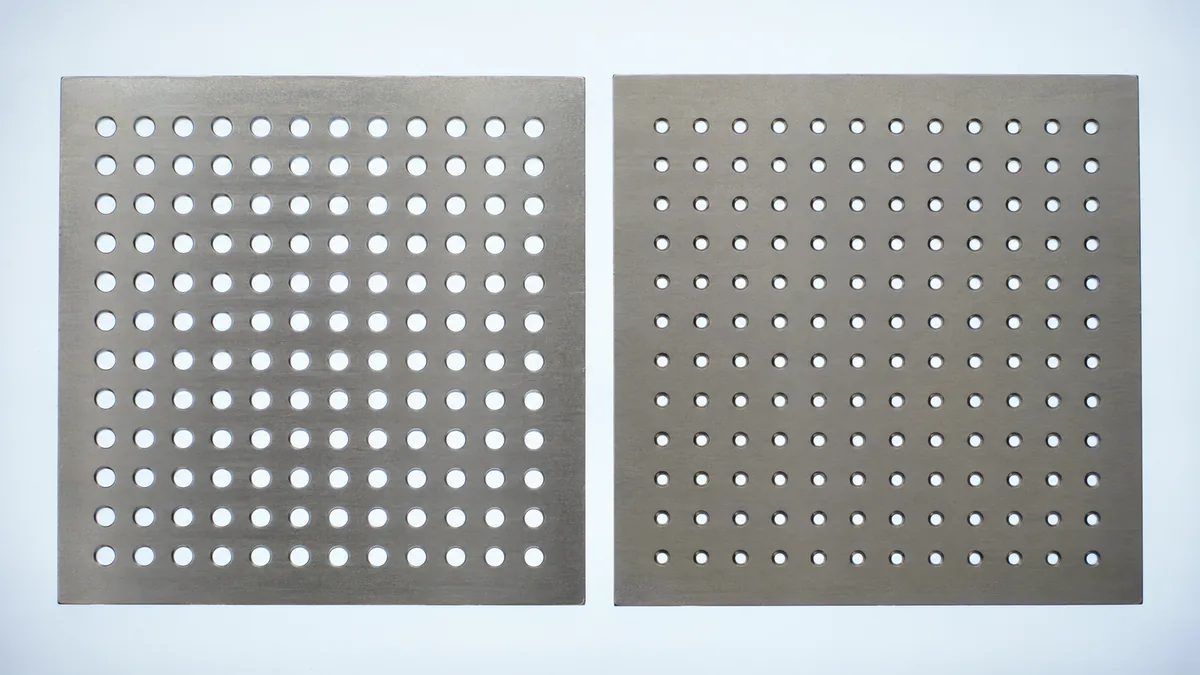
The last move is to check. Taper is invisible from the top, so a part can look perfect and still be coned through its thickness. Measuring the feature at both faces, or sectioning a sample, is what turns taper from a surprise at assembly into a number on an inspection report.
When taper matters, and when it does not
Not every part needs square walls, and knowing which do keeps the process from being over-constrained.
Parts where the wall angle is critical
A press-fit, a mating feature, a precision aperture, or a part that stacks against others needs its walls close to square, because the fit is made at both faces and a cone throws it off. On these, taper is a controlled parameter with a tolerance of its own, not an afterthought.
Parts where it is cosmetic
On a vented panel, a decorative pattern, or a feature that only has to pass light or air, a small wall angle changes nothing that matters. Holding tight taper there spends process margin for no function, which is its own kind of mistake. The point is to decide where on that spectrum a part sits before cutting it.
Focus is a moving target
Taper is one of those defects that looks like a programming error and is actually a physics problem. The beam narrows to a waist and widens again, the Rayleigh range sets how long it stays narrow, and the thickness of the part decides whether that is long enough. Everything after that is a matter of putting the waist in the right place and keeping it there while the cut is made.
The parts that come out square are the ones where the depth of focus was matched to the thickness, the material was held flat, and the focus was treated as something to control rather than set once and trust. Taper is not a limit of laser micromachining so much as a reading of how well the focus was managed.